






 AI Development
 Agentic AI Development
 AI-Product-Engineering
 Generative AI Development
 AI Chatbot Development
 RAG Development
 AI MCP Development
 n8n Automation Development
 AI Consulting
Piccosoft

Picco Labs
Picco AI
Piccosoft

Conversational Search Solutions
Find Business Information Through Natural Conversations
Transform how users search for information with AI-powered conversational search that understands natural language, retrieves relevant knowledge, and delivers contextual answers across your business information sources.

Implement AI Where It Creates Real Business Value
Why Businesses Struggle to Implement AI
From Business Requirements to AI Implementation
What We Deliver
Where Can Your Business Implement AI?
Technologies That Power Our AI Solutions
Connect AI with Your Existing Business Ecosystem
Why Businesses Choose Piccosoft
Build a More Intelligent and Efficient Business
Frequently Asked Questions
Overview
Traditional search often requires users to know the right keywords, navigate multiple systems, and manually identify relevant information. Conversational search changes this experience. Users can ask questions naturally, explore related information, refine their queries, and discover answers through interactive conversations.
Identify AI Opportunities
Discover where AI can create meaningful improvements across your business. Prioritize use cases based on business value, feasibility, and expected impact.
Automate Business Processes
Reduce repetitive manual work through intelligent workflow automation. Help teams focus on higher-value activities and operational responsibilities.
Integrate AI with Existing Systems
Connect AI capabilities with applications, APIs, and databases. Enable intelligent workflows without replacing your entire technology environment.
Improve Knowledge Access
Make business information easier to search, understand, and use. Connect AI with documents, databases, and internal knowledge sources.
Build AI Applications
Develop custom AI applications, assistants, and intelligent business solutions. Design experiences around specific users, processes, and organizational requirements.
Create an AI Roadmap
Plan AI adoption through practical and achievable implementation stages. Start with focused use cases and expand capabilities as your business grows.
Why Traditional Search Falls Short
Businesses often face challenges related to AI strategy, data, integration, security, and technical expertise. Our implementation approach addresses these challenges through practical planning and engineering.

Keyword Dependency
Users must know the right terms to find relevant information.
Read more

Information Fragmentation
Knowledge is distributed across documents, applications, databases, and platforms.
Read moreToo Many Search Results
Users struggle to identify the most relevant information among large result sets.
Read moreLimited Context Understanding
Traditional search often fails to understand the meaning behind questions..
Read moreRepeated Information Requests
Employees repeatedly ask colleagues for information already available internally.
Read moreDisconnected Search Experiences
Users need to search different systems separately to complete a single information task.
Read moreFrom Questions to Contextual Answers
We follow a structured approach to transform business requirements into working AI solutions. Each stage focuses on business value, technical feasibility, and continuous improvement.
Query Understanding
Understand user questions, intent, context, entities, and information requirements.
Knowledge Source Connectivity
Connect documents, databases, business applications, knowledge repositories, and supported information sources.
Intelligent Retrieval
Retrieve relevant information using semantic search, hybrid retrieval, metadata filtering, and contextual ranking.
Contextual Response Generation
Use relevant retrieved information to generate meaningful responses to user questions.
Conversation & Exploration
Enable follow-up questions, query refinement, contextual exploration, and multi-turn conversations.
Search Quality Improvement
Evaluate relevance, retrieval quality, response accuracy, and user experience to improve the search system.
Intelligent Search Experiences for Your Users
We deliver AI capabilities designed around business requirements and existing technology environments. Our services cover strategy, development, integration, automation, and deployment.
Natural Language Search
Allow users to search using everyday language instead of specific keywords.
Semantic Search
Understand the meaning and intent behind user queries.
Context-Aware Retrieval
Retrieve information based on the conversation and query context.
Multi-Source Search
Search across connected documents, databases, platforms, and knowledge sources
AI Answer Generation
Generate contextual answers using retrieved information.
Follow-Up Questions
Maintain conversational context for continuing information discovery.
Search Refinement
Help users narrow, clarify, and improve their search queries.
Source References
Provide relevant document or source references where supported.
Natural-Language Search Across Business Information
AI can be implemented across departments, processes, and business functions. We develop solutions based on your operational requirements and business priorities.
1. Enterprise Knowledge Search
Search company information, policies, procedures, and internal knowledge.
2. Customer Support Search
Help support teams and customers find answers across support documentation.
3. Product & Technical Search
Search product specifications, manuals, technical documentation, and knowledge.
4. Business Application Search
Discover information across connected business systems.
5. Employee Information Search
Help employees access internal resources and organisational information.
6. Research & Information Discovery
Explore reports, documents, research materials, and related knowledge.
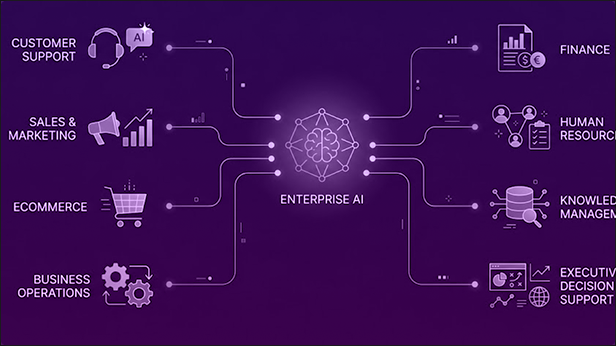
Technology & Integration
Organize and connect business knowledge through AI-powered systems. Help employees discover information and access organizational knowledge.
Infrastructure
Connect Conversational Search to Your Information Ecosystem
AI delivers greater value when it works with existing business systems and workflows. We integrate intelligent capabilities across applications, platforms, data sources, and communication tools.
Document Platforms
Search across document repositories, files, manuals, and knowledge content.
Business Databases
Connect structured data and business records for contextual search.
Enterprise Applications
Integrate with CRM, ERP, HRMS, ecommerce, and operational systems.
Knowledge Platforms
Connect enterprise knowledge bases, content platforms, and internal information systems.
Third-Party APIs
Retrieve information from external services and connected platforms.
Identity & Access Management
Apply user identity, role-based permissions, and access-aware search.
AI & Retrieval Infrastructure
Integrate LLMs, vector databases, embeddings, retrieval pipelines, and orchestration.
Building Search Experiences Around How People Work
Piccosoft combines business understanding, software engineering, and modern AI capabilities. We focus on practical solutions that integrate with existing technology environments.

AI Search Engineering
Combine semantic retrieval, RAG, query understanding, and AI generation.

Business-Centred Search Design
Design search experiences around real information requirements.

Connected Knowledge Architecture
Bring distributed business information into a unified search experience.

Custom Search Applications
Build tailored search interfaces, APIs, and application experiences.

Enterprise Integration Expertise
Connect search with business systems, databases, and knowledge sources.

End-to-End Delivery
From search architecture and development to deployment and optimisation.
Make Information Easier to Discover and Use
Well-planned AI implementation can improve how teams work and businesses operate. We focus on productivity, efficiency, customer experience, and sustainable growth.
Simpler Information Discovery
Allow users to find information using natural language.
Reduced Search Effort
Reduce manual navigation and repetitive searching across systems.
Better Contextual Answers
Improve access to information that is relevant to the question.
Connected Search Experiences
Discover knowledge across multiple information sources.
Improved Employee Productivity
Spend less time searching and more time acting on information.
Better Knowledge Accessibility
Make organisational information easier for authorised users to access.
Frequently Asked Questions
Conversational search allows users to interact with a search system through natural-language questions and follow-up conversations rather than relying only on keywords or traditional search filters.
Traditional search typically returns matching results for keywords or queries. Conversational search can understand intent, retrieve relevant contextual information, and generate answers while supporting follow-up questions.
Yes. Conversational search can connect with supported internal data sources, including documents, knowledge repositories, databases, and business applications.
Yes. Conversational search applications can maintain conversational context and support follow-up queries, clarifications, and deeper exploration of retrieved information.
Yes. We can develop multi-source retrieval architectures that search across connected documents, databases, APIs, and supported enterprise systems.
Yes. Applications can be designed to provide references to relevant source documents, records, or information wherever the retrieval architecture supports source tracking.
Yes. User identity, roles, permissions, and access-aware retrieval can be incorporated into the search architecture to control information access.
Yes. Conversational search can be integrated into websites, SaaS platforms, internal applications,
Timelines vary by scope, but a focused pilot can often launch within weeks, with broader rollout phased over several months. Starting with one high-value process allows the business to see measurable results early, before expanding to additional areas.