






 AI Development
 Agentic AI Development
 AI-Product-Engineering
 Generative AI Development
 AI Chatbot Development
 RAG Development
 AI MCP Development
 n8n Automation Development
 AI Consulting
Piccosoft

Picco Labs
Picco AI
Piccosoft

AI Knowledge Management Solutions
Transform Business Knowledge into Intelligent Decision Support
Make organisational knowledge easier to capture, manage, discover, and use. Piccosoft builds AI-powered knowledge management solutions that connect business information, documents, expertise, and workflows to help teams make better use of enterprise knowledge.

Implement AI Where It Creates Real Business Value
Why Businesses Struggle to Implement AI
From Business Requirements to AI Implementation
What We Deliver
Where Can Your Business Implement AI?
Technologies That Power Our AI Solutions
Connect AI with Your Existing Business Ecosystem
Why Businesses Choose Piccosoft
Build a More Intelligent and Efficient Business
Frequently Asked Questions
Overview
Businesses continuously create knowledge through documents, conversations, projects, processes, customer interactions, and operational activities. However, much of this knowledge remains scattered, underutilised, or difficult to access when needed.Piccosoft develops AI-powered knowledge management solutions that help organisations bring their knowledge together, organise information, improve discovery, and make knowledge available through intelligent interfaces.
Identify AI Opportunities
Discover where AI can create meaningful improvements across your business. Prioritize use cases based on business value, feasibility, and expected impact.
Automate Business Processes
Reduce repetitive manual work through intelligent workflow automation. Help teams focus on higher-value activities and operational responsibilities.
Integrate AI with Existing Systems
Connect AI capabilities with applications, APIs, and databases. Enable intelligent workflows without replacing your entire technology environment.
Improve Knowledge Access
Make business information easier to search, understand, and use. Connect AI with documents, databases, and internal knowledge sources.
Build AI Applications
Develop custom AI applications, assistants, and intelligent business solutions. Design experiences around specific users, processes, and organizational requirements.
Create an AI Roadmap
Plan AI adoption through practical and achievable implementation stages. Start with focused use cases and expand capabilities as your business grows.
The Challenges of Managing Organisational Knowledge
Businesses often face challenges related to AI strategy, data, integration, security, and technical expertise. Our implementation approach addresses these challenges through practical planning and engineering.

Knowledge Silos
Important information is spread across departments, applications, documents, and individual employees.
Read more

Knowledge Discovery Difficulties
Employees struggle to find relevant information across multiple systems and repositories.
Read moreUnstructured Information
Business knowledge exists in different formats, making it difficult to organise, analyse, and retrieve consistently.
Read moreKnowledge Maintenance
Keeping information accurate, current, and relevant across multiple sources can be challenging.
Read moreLimited Knowledge Reuse
Teams often recreate information, repeat research, or solve problems that have already been addressed elsewhere in the organisation.
Read moreLoss of Institutional Knowledge
Valuable expertise and business context may be lost when employees leave or change roles.
Read moreCreate a Smarter Knowledge Lifecycle
We follow a structured approach to transform business requirements into working AI solutions. Each stage focuses on business value, technical feasibility, and continuous improvement.
Knowledge Assessment
Identify existing knowledge assets, repositories, information flows, departments, and knowledge management challenges.
Knowledge Capture
Connect information from documents, databases, business applications, workflows, and other knowledge sources.
Knowledge Organisation
Structure information using categories, metadata, relationships, tags, and relevant knowledge models.
Intelligent Knowledge Discovery
Implement semantic search, contextual retrieval, AI-powered question answering, and information discovery.
Knowledge Activation
Make knowledge accessible through AI assistants, business applications, dashboards, search interfaces, and automated workflows.
Knowledge Maintenance and Improvement
Support content updates, knowledge quality, usage insights, and continuous improvement of the knowledge ecosystem.
Intelligent Knowledge Management Across the Enterprise
We deliver AI capabilities designed around business requirements and existing technology environments. Our services cover strategy, development, integration, automation, and deployment.
AI Knowledge Capture
Collect and process business knowledge from documents, databases, applications, and organisational information sources.
Knowledge Organisation and Classification
Organise information using categories, metadata, tags, topics, entities, and structured knowledge models.
Intelligent Knowledge Search
Enable employees to discover relevant information through semantic search and natural-language queries.
AI Knowledge Assistants
Build AI assistants that help employees access, understand, summarise, and use business knowledge.
Knowledge Extraction and Summarisation
Extract key information, insights, concepts, and summaries from large volumes of business content.
Knowledge Relationship Mapping
Connect related information, concepts, documents, business entities, and knowledge topics.
Knowledge Workflow Automation
Automate knowledge-related activities such as information classification, content routing, summarisation, and knowledge updates.
Knowledge Analytics
Analyse search activity, usage patterns, information gaps, and knowledge engagement.
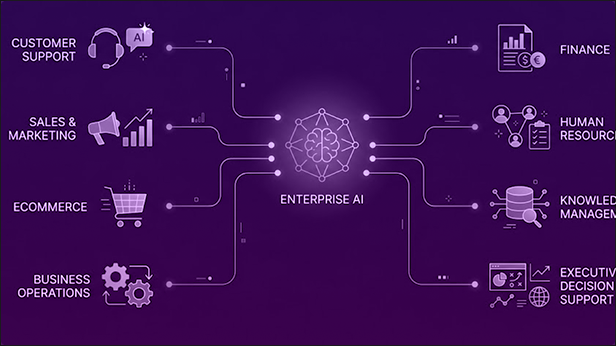
Apply AI Knowledge Management Across Your Business
AI can be implemented across departments, processes, and business functions. We develop solutions based on your operational requirements and business priorities.
1. Employee Knowledge Management
Make internal policies, procedures, benefits, onboarding information, and company knowledge accessible to employees.
2. Customer Knowledge Management
Connect customer information, support history, product knowledge, FAQs, and service documentation.3. Project Knowledge Management
Capture project documents, decisions, discussions, requirements, lessons learned, and project information.
4. Technical Knowledge Management
Organise engineering documentation, technical guides, troubleshooting information, specifications, and development knowledge.
5. Operations Knowledge Management
Make operational procedures, process documentation, standards, and business guidelines accessible across teams.
6. Sales Knowledge Management
Enable sales teams to access proposals, product information, case studies, pricing knowledge, and sales resources.
Technology & Integration
Organize and connect business knowledge through AI-powered systems. Help employees discover information and access organizational knowledge.
Infrastructure
Connect Knowledge with People, Applications, and Workflows
AI delivers greater value when it works with existing business systems and workflows. We integrate intelligent capabilities across applications, platforms, data sources, and communication tools.
Enterprise Content Platforms
Connect document management systems, shared drives, content repositories, and knowledge portals.
Business Applications
Integrate knowledge with ERP, CRM, HRMS, finance, ecommerce, and enterprise applications.
Databases and Information Sources
Connect relational databases, business records, data repositories, and structured information.
Communication Platforms
Integrate knowledge with internal communication, collaboration, and employee support channels.
AI and Retrieval Infrastructure
Connect LLMs, embedding services, vector databases, retrieval pipelines, and AI services.
Workflow and Automation Platforms
Integrate knowledge workflows with business process automation, notifications, and task systems.User Identity and Access Systems
Support user authentication, permissions, and knowledge access according to organisational requirements.
Build Knowledge Systems That Support the Way Your Business Works
Piccosoft combines business understanding, software engineering, and modern AI capabilities. We focus on practical solutions that integrate with existing technology environments.

AI and Knowledge Engineering
We combine AI development, retrieval systems, data engineering, and application development to build practical knowledge solutions.

Business-Centred Knowledge Design
We consider how information is created, shared, maintained, and used across your organisation.

Connected Knowledge Architecture
We connect information from multiple sources to support a unified knowledge experience.

Custom Knowledge Solutions
We design knowledge systems based on your organisational structure, workflows, business domains, and requirements.

Integration with Business Applications
We help bring knowledge capabilities into the applications and workflows your teams already use.

End-to-End Implementation
From knowledge discovery and architecture to AI development, integration, deployment, and continuous improvement.
Improve the Way Your Organisation Uses Knowledge
Well-planned AI implementation can improve how teams work and businesses operate. We focus on productivity, efficiency, customer experience, and sustainable growth.
Better Knowledge Accessibility
Make organisational knowledge easier to discover and use.
Improved Knowledge Reuse
Reduce repeated research and duplicated work.
Preserved Institutional Knowledge
Capture valuable expertise and business context.
Faster Employee Productivity
Help teams access information without unnecessary searching.
Connected Business Knowledge
Bring information together across departments and systems.
Better Decision Support
Provide employees with relevant information and context when making decisions.
Frequently Asked Questions
AI knowledge management uses AI technologies to capture, organise, retrieve, analyse, and distribute organisational knowledge more effectively.
A knowledge base primarily stores and organises information. AI knowledge management extends this through intelligent discovery, summarisation, knowledge extraction, contextual assistance, and knowledge workflows.
Yes. AI knowledge management solutions can connect information across departments while maintaining appropriate access controls and organisational structures.
Yes. Knowledge systems can connect documents, databases, business applications, APIs, and existing information repositories.
AI can help analyse search activity, recurring questions, missing information, and knowledge usage patterns to identify areas that may need additional content.
Yes. Employees can use AI-powered knowledge interfaces to access policies, procedures, training information, internal guidelines, and company resources.
Yes. Knowledge capabilities can be integrated into business applications, employee portals, workflows, and internal systems.
Yes. We can build custom knowledge management platforms with knowledge ingestion, organisation, retrieval, AI interfaces, integrations, governance, and analytic