





 React Native Development
 Angularjs 2 Development
 Angularjs Development
 Nodejs Development

 AI Development
 Agentic AI Development
 AI-Product-Engineering
 Generative AI Development
 AI Chatbot Development
 RAG Development
 AI MCP Development
 n8n Automation Development
 AI Consulting
Piccosoft

Picco Labs
Picco AI
Piccosoft

AI Orchestration & Automation Platforms
Connect AI, Applications, and Workflows to Automate Business Operations
Build intelligent automation platforms that connect AI models, business applications, APIs, and workflows. Piccosoft helps businesses orchestrate AI-powered processes, coordinate multiple systems, and automate complex business operations.
Implement AI Where It Creates Real Business Value
Why Businesses Struggle to Implement AI
From Business Requirements to AI Implementation
What We Deliver
Where Can Your Business Implement AI?
Technologies That Power Our AI Solutions
Connect AI with Your Existing Business Ecosystem
Why Businesses Choose Piccosoft
Build a More Intelligent and Efficient Business
Frequently Asked Questions
Overview
AI becomes more valuable when it can work across business applications, access relevant information, and coordinate tasks through structured workflows.
Identify AI Opportunities
Discover where AI can create meaningful improvements across your business. Prioritize use cases based on business value, feasibility, and expected impact.
Automate Business Processes
Reduce repetitive manual work through intelligent workflow automation. Help teams focus on higher-value activities and operational responsibilities.
Integrate AI with Existing Systems
Connect AI capabilities with applications, APIs, and databases. Enable intelligent workflows without replacing your entire technology environment.
Improve Knowledge Access
Make business information easier to search, understand, and use. Connect AI with documents, databases, and internal knowledge sources.
Build AI Applications
Develop custom AI applications, assistants, and intelligent business solutions. Design experiences around specific users, processes, and organizational requirements.
Create an AI Roadmap
Plan AI adoption through practical and achievable implementation stages. Start with focused use cases and expand capabilities as your business grows.
Challenges in Managing Connected Business Workflows
Businesses often face challenges related to AI strategy, data, integration, security, and technical expertise. Our implementation approach addresses these challenges through practical planning and engineering.

Disconnected Applications
Business applications often operate independently, requiring employees to move information between systems manually.
Read more

Repetitive Manual Tasks
Routine activities such as reading emails, extracting information, updating records, and generating reports consume valuable time.
Read moreFragmented Automation
Separate automation tools may not provide a coordinated approach across multiple business processes.
Read moreLimited Workflow Intelligence
Traditional workflows follow predefined rules and may struggle with unstructured information or changing business contexts.
Read moreLack of Process Visibility
Managing multiple automated processes can become difficult without centralised monitoring and execution tracking.
Read moreHuman Dependency for Routine Decisions
Employees may spend time reviewing, classifying, and routing information that could be assisted by AI.
Read moreFrom Individual AI Tasks to Connected Business Automation
We follow a structured approach to transform business requirements into working AI solutions. Each stage focuses on business value, technical feasibility, and continuous improvement.
Workflow Discovery
Understand existing business processes, applications, repetitive activities, decision points, and automation opportunities.
Automation Architecture
Design the workflow structure, AI components, integrations, execution logic, and human approval points.
AI and Tool Connectivity
Connect AI models, agents, APIs, databases, and business applications required by each workflow.
Workflow Orchestration
Configure triggers, conditional logic, task sequences, data exchange, and coordination between different services.
Human-in-the-Loop Controls
Introduce review, approval, escalation, and exception-handling steps wherever human involvement is required.
Monitoring and Optimisation
Track workflow execution, identify failures, review outcomes, and improve automation performance.
Build Connected and Intelligent Automation Systems
We deliver AI capabilities designed around business requirements and existing technology environments. Our services cover strategy, development, integration, automation, and deployment.
AI Workflow Automation
Automate multi-step business processes by combining AI capabilities, application integrations, and workflow logic.
AI Agent Orchestration
Coordinate multiple AI agents to perform specialised tasks, exchange information, and complete connected workflows.
Business Process Automation
Automate repetitive operational activities across departments and business applications.
AI and API Orchestration
Connect AI services with internal APIs, external services, databases, and enterprise applications.
Event-Driven Automation
Trigger workflows based on incoming emails, application events, data changes, scheduled activities, and other business events.
Document and Information Processing
Automate document classification, information extraction, summarisation, and downstream business actions.
Approval and Exception Workflows
Build human review, approval, escalation, and exception-handling processes into automated operations.
Workflow Monitoring and Management
Track execution status, workflow activity, errors, and operational performance.
Intelligent Automation Across Business Functions
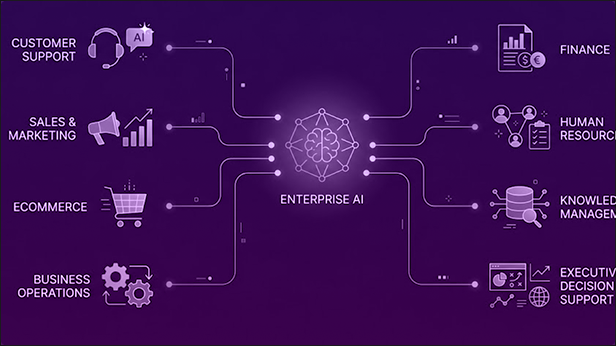
AI can be implemented across departments, processes, and business functions. We develop solutions based on your operational requirements and business priorities.
1.Email and Communication Automation
Read incoming emails, classify requests, extract relevant information, prepare responses, and route tasks to the right teams.
2. AI-Powered Customer Support
Coordinate customer queries, knowledge retrieval, ticket creation, response generation, and escalation workflows.
3. Sales Process Automation
Automate lead qualification, CRM updates, follow-ups, meeting summaries, and sales activity coordination.
4. HR Workflow Automation
Support employee queries, onboarding activities, document processing, and HR task coordination.
5. Business Operations Automation
Extract invoice information, validate records, route approvals, and connect finance workflows with accounting systems.
6. AI for Human Resources
Coordinate operational tasks, update application records, generate reports, and notify relevant stakeholders.
Technology & Integration
Organize and connect business knowledge through AI-powered systems. Help employees discover information and access organizational knowledge.
Infrastructure
Connect AI Automation with Your Business Systems
AI delivers greater value when it works with existing business systems and workflows. We integrate intelligent capabilities across applications, platforms, data sources, and communication tools.
Email and Communication Platforms
Connect email services, messaging platforms, and communication channels to trigger and manage workflows.Enterprise Applications
Integrate ERP, CRM, HRMS, finance, ecommerce, and other business applications.
AI Models and Agents
Connect multiple AI models and agents to coordinate tasks and process business information.
APIs and External Services
Integrate third-party APIs, internal services, and external business platforms.
Databases and Knowledge Sources
Connect operational databases, document repositories, and vector databases for contextual workflow execution.
Workflow and Automation Tools
Integrate automation engines, event triggers, scheduling services, and orchestration components.
MCP-Based Tool Connectivity
Enable AI agents to interact with supported business tools and services through Model Context Protocol integrations.
Engineering Intelligent Workflows Around Your Business
Piccosoft combines business understanding, software engineering, and modern AI capabilities. We focus on practical solutions that integrate with existing technology environments.

AI and Automation Engineering
We combine AI development, application engineering, APIs, and workflow automation.

Business Process Understanding
We focus on understanding how work moves across teams, systems, and business operations.

Connected Application Architecture
We design workflows that bring multiple applications and services together.

Flexible Orchestration Design
We can build custom orchestration solutions or integrate suitable workflow automation platforms.

Controlled Automation
We incorporate approvals, access controls, exception handling, and human oversight where needed.

End-to-End Implementation
From workflow discovery and architecture to integration, deployment, and optimisation, we support the automation lifecycle.
Make Business Processes More Connected and Efficient
Well-planned AI implementation can improve how teams work and businesses operate. We focus on productivity, efficiency, customer experience, and sustainable growth.
Reduced Manual Work
Automate repetitive tasks and information handling.
Connected Operations
Coordinate workflows across applications and departments.
Faster Execution
Reduce delays between process steps and system updates.
Improved Visibility
Monitor workflow activity, execution status, and exceptions.
Consistent Processes
Apply structured workflow logic and approval controls.
Scalable Automation
Extend successful workflows across additional business functions.
Frequently Asked Questions
AI orchestration coordinates AI models, agents, APIs, data sources, and applications to execute connected tasks and business workflows.
AI automation focuses on automating individual tasks or processes. AI orchestration coordinates multiple tasks, services, agents, and systems within a broader workflow.
Yes. We can use n8n and other suitable automation technologies to connect AI services, APIs, and business applications based on project requirements.
Yes. Multiple agents can be assigned different responsibilities and coordinated through an orchestration layer with defined tools, instructions, and controls.
CRM development is the process of designing and building software that helps businesses manage customer relationships, sales activities, marketing campaigns, and customer support.
Yes. For example, an AI workflow can process incoming emails, extract information, update CRM records, create tasks, and route items for approval.
Yes. Human-in-the-loop steps can be introduced for approvals, sensitive actions, exceptions, and decisions that require employee review.
Yes. We can develop custom platforms to manage AI agents, workflows, integrations, execution status, and automation operations.