



 React Native Development
 Angularjs 2 Development
 Angularjs Development
 Nodejs Development

 AI Development
 Agentic AI Development
 AI-Product-Engineering
 Generative AI Development
 AI Chatbot Development
 RAG Development
 AI MCP Development
 n8n Automation Development
 AI Consulting
Piccosoft

Picco Labs
Picco AI
Piccosoft

Enterprise AI Assistant Development
Build AI assistants for your entire enterprise.
We build enterprise AI assistants that connect employees with organizational knowledge, business systems, and everyday workflows.Designed with security, governance, scalability, and enterprise integration in mind, our assistants can support teams across the organization.
Implement AI Where It Creates Real Business Value
Why Businesses Struggle to Implement AI
From Business Requirements to AI Implementation
What We Deliver
Where Can Your Business Implement AI?
Technologies That Power Our AI Solutions
Connect AI with Your Existing Business Ecosystem
Why Businesses Choose Piccosoft
Build a More Intelligent and Efficient Business
Frequently Asked Questions
Implement AI Where It Creates Real Business Value
AI implementation is more than connecting an AI model to your application. We identify suitable opportunities, integrate intelligent technologies, and develop solutions around your business requirements.
Enterprise Knowledge Access
Connect employees with organizational knowledge across approved information sources.Make relevant business information easier to discover and use.
Role-Based Assistance
Design assistant experiences around employee roles, departments, and responsibilities.Users can receive relevant information based on their business context.
Secure AI Interaction
Build controlled access to enterprise information and capabilities.Security and permissions remain part of the assistant architecture.
Business System Connectivity
Connect assistants with enterprise applications, APIs, and databases.This enables AI to work alongside existing business systems.
Enterprise Workflow Support
Support processes across HR, finance, sales, operations, IT, and other functions.Assistants can help employees navigate and complete defined workflows.
Scalable AI Adoption
Start with a focused enterprise use case and expand across departments.The architecture can support broader organizational AI adoption over time.
Enterprise AI Comes With Enterprise-Level Challenges
Large organizations operate across multiple teams, systems, data sources, and security boundaries.An enterprise AI assistant must work within these realities while remaining useful and controlled.

Information Across Multiple Systems
Enterprise knowledge is distributed across applications, documents, databases, and repositories.Employees need a simpler way to access relevant information.
Read more

Complex Access Requirements
Different employees have different responsibilities and information access.AI experiences must respect organizational permissions and boundaries.
Read moreLegacy & Modern Systems
Enterprises often operate a combination of legacy and modern applications.Connecting AI across this environment requires thoughtful integration.
Read moreInconsistent Internal Knowledge
Processes and information can vary across departments and locations.Employees may struggle to identify the right source of information.
Read moreEnterprise Governance Requirements
Organizations need visibility and control over how AI is used.Assistants need appropriate governance, monitoring, and operational controls.
Read moreScaling Beyond AI Pilots
A successful AI proof of concept can be difficult to expand across the organization.Enterprise architecture must support growth from individual use cases to broader adoption.
Read moreFrom Enterprise Requirements to Production AI
We design enterprise assistants around users, data, applications, security requirements, and business processes.Our approach helps organizations move from an initial use case toward scalable enterprise adoption.
Enterprise Discovery
We understand business functions, users, systems, data sources, and operational requirements.
Use Case & Scope Definition
We identify the highest-value business functions for AI assistance.
Enterprise Architecture Design
We define the AI models, knowledge layer, integrations, workflows, access controls, and infrastructure.
Knowledge & Data Integration
Relevant enterprise information sources are connected to the assistant.
System & Workflow Integration
The assistant is connected with required applications, APIs, and business processes.
Enterprise Deployment & Optimization
We validate security, performance, usability, and operational behaviour before wider deployment.
Capabilities for Enterprise AI Experiences
We combine conversational intelligence with enterprise knowledge, integrations, access controls, and workflow capabilities.Each capability can be configured around the organization's specific operating model.
Enterprise Conversational AI
Provide employees with a natural language interface to enterprise information.
Users can interact with business knowledge without navigating multiple systems.
Enterprise RAG & Knowledge Access
Retrieve relevant information from approved organizational knowledge sources.
Responses can be grounded in enterprise-specific content.
Role-Based Intelligence
Customize information and assistant behaviour based on user roles and responsibilities.This helps provide relevant experiences across departments.
Enterprise System Integration
Connect the assistant with business applications, APIs, and databases.Users can access information and defined capabilities through the assistant.
RAG & Knowledge Intelligence
Connect AI applications with internal business knowledge and documents.Deliver relevant, context-aware responses through retrieval-based intelligence.
AI Model Integration
Integrate suitable AI models into applications and business platforms.Select models based on performance, functionality, and project requirements.
Workflow Assistance
Support multi-step enterprise processes and everyday employee workflows.Assistants can guide users through defined procedures.
Human Approval Controls
Require employee approval for sensitive or important actions.
This provides additional control over AI-supported workflows.
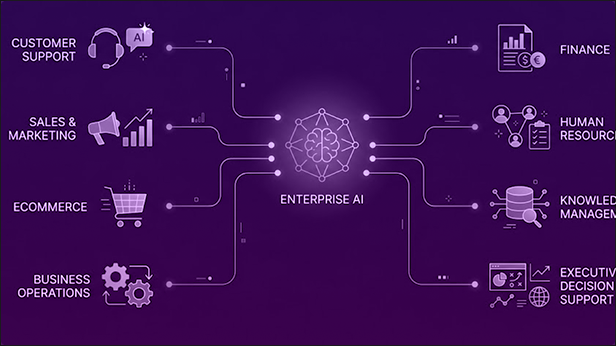
AI Assistance Across the Enterprise
Enterprise assistants can support employees and business functions across the organization.We develop focused experiences that can later expand into a connected enterprise AI ecosystem.
1. Enterprise Knowledge Assistant
Help employees find policies, procedures, documentation, and organizational knowledge.
2. HR & Employee Assistant
Support employees with HR policies, benefits, leave, onboarding, and internal processes.
3. IT Service Assistant
Help employees resolve common technology questions and navigate IT processes.
4. Finance Assistant
Help teams access approved financial information, procedures, and documentation.
5. Sales & Customer Assistant
Give sales teams access to product information, customer context, and sales resources.
6. Operations Assistant
Support operational teams with procedures, knowledge, and workflow information.
Technologies That Power Our AI Solutions
The AI technologies and frameworks we use to build intelligent, scalable solutions
Infrastructure
Connect Enterprise AI With Your Technology Landscape
Enterprise assistants need to work with the systems employees already depend on.We integrate AI assistants with enterprise applications, data, identity systems, and business workflows.
Enterprise Application Integration
Connect assistants with ERP, CRM, HR, finance, commerce, and operational applications.
Enterprise Data Integration
Connect structured and unstructured enterprise information sources.
API Integration
Integrate internal and external APIs required by enterprise workflows.
Database Integration
Connect assistants with approved enterprise databases and data platforms.
Identity & Access Integration
Integrate enterprise authentication and authorization mechanisms.
Workflow Integration
Connect AI assistance with existing enterprise processes and workflows.
Knowledge Repository Integration
Connect approved document repositories and organizational knowledge platforms.
Cloud & Infrastructure Integration
Deploy enterprise assistants within suitable cloud or infrastructure environments.
Compliance & Governance Integration
Integrate the assistant with enterprise compliance frameworks, data retention policies, and regulatory requirements relevant to your industry.
Monitoring & Analytics Integration
Connect the assistant to enterprise observability, usage analytics, and performance-tracking systems.
Engineering Enterprise AI With Business and Technology in Mind
Enterprise AI requires more than model integration-it requires software engineering, system integration, security thinking, and operational understanding.We bring these capabilities together to build practical enterprise AI assistants.

Enterprise Engineering Approach
We consider architecture, integrations, security, scalability, and maintainability from the beginning.

AI & Software Expertise
Our approach combines AI engineering with application and platform development.

Integration-First Thinking
We design assistants to work with existing enterprise applications and data.

Custom Enterprise Architecture
Every organization has different systems, users, and governance requirements.

Production-Oriented Delivery
We focus on reliability, monitoring, security, and operational readiness.

Long-Term Partnership
Enterprise AI adoption is an ongoing journey rather than a one-time implementation.
Create a More Intelligent Enterprise
Enterprise AI assistants can make organizational knowledge more accessible and help employees work more efficiently.The result is a practical foundation for expanding AI across business functions.
Faster Employee Productivity
Employees can access information and assistance without navigating multiple systems.
Better Knowledge Accessibility
Enterprise knowledge becomes easier to discover through natural language interaction.
Reduced Support Workload
AI assistants can handle repetitive first-level questions across business functions.
More Connected Workflows
AI can provide an interaction layer across existing enterprise systems.
Consistent Business Assistance
Organizations can provide standardized AI-supported guidance across teams.
Scalable Enterprise AI Foundation
Organizations can expand from individual assistants to broader AI adoption.
Frequently Asked Questions
An enterprise AI assistant is an AI-powered system designed to support employees or business functions across an organization.
It can connect with enterprise knowledge, applications, data, and defined workflows.
Enterprise assistants are designed around organizational requirements such as security, permissions, governance, integrations, and scalability.They can support larger user groups and more complex technology environments.
Yes, an enterprise assistant platform can support different departments and business functions.Each department can have relevant knowledge, workflows, and capabilities.
Yes, role-based access can be incorporated into the assistant architecture.Users can be provided access according to defined organizational permissions.
Yes, assistants can integrate with approved applications, APIs, databases, and knowledge systems.The integration approach depends on your existing technology environment.
Yes, assistants can be connected to approved tools and business workflows where action execution is required.Sensitive operations can include human approval and additional controls.
Yes, an enterprise AI initiative can begin with one high-value department or use case.The architecture can then expand to additional teams, systems, and workflows.
Yes, enterprise data can be protected using existing security controls, encryption standards, and access permissions. The assistant operates within your organization's data governance policies rather than introducing new exposure.
This can be structured as a shared responsibility - your internal IT or AI team manages day-to-day configuration and permissions, while the implementation partner provides ongoing support for upgrades, integrations, and new use cases as the initiative scales.