



 React Native Development
 Angularjs 2 Development
 Angularjs Development
 Nodejs Development

 AI Development
 Agentic AI Development
 AI-Product-Engineering
 Generative AI Development
 AI Chatbot Development
 RAG Development
 AI MCP Development
 n8n Automation Development
 AI Consulting
Piccosoft

Picco Labs
Picco AI
Piccosoft

Custom AI Assistant Development
Build AI assistants designed around the way your people work.
We build custom AI assistants that understand your business context, knowledge, and workflows to support employees, customers, and teams.From a focused knowledge assistant to a task-oriented business assistant, we create experiences tailored to your needs.
Implement AI Where It Creates Real Business Value
Why Businesses Struggle to Implement AI
From Business Requirements to AI Implementation
What We Deliver
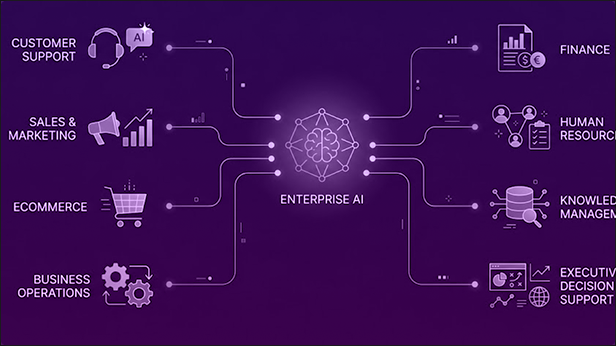
Where Can Your Business Implement AI?
Technologies That Power Our AI Solutions
Connect AI with Your Existing Business Ecosystem
Why Businesses Choose Piccosoft
Build a More Intelligent and Efficient Business
Frequently Asked Questions
AI Assistants Built for Your Business
Every business has different users, workflows, knowledge, and challenges.We develop AI assistants around those specific requirements instead of relying on generic AI experiences.
Personalized AI Experiences
Design assistants around specific users, teams, and business functions.Each assistant can be tailored to its intended purpose.
Business Knowledge Access
Connect assistants with relevant documents, databases, and organizational knowledge.
Users can access information through natural language conversations.
Context-Aware Assistance
Assistants understand the conversation and relevant business context.This helps provide more useful and consistent responses.
Task Assistance
Enable assistants to support defined business tasks and workflows.
They can guide users or perform approved actions through connected tools.
User-Specific Intelligence
Assistants can adapt their responses based on user roles and requirements.This creates more relevant experiences across different teams.
Human-Centered Interaction
Build assistants that work naturally alongside employees and customers.The experience remains simple while the underlying intelligence handles complexity.
Why Businesses Need Custom AI Assistants
Generic AI tools may provide answers, but they often lack your organization's context and workflows.Custom assistants bring AI closer to the information and tasks people use every day.
Generic AI Doesn't Understand the Business
Employees often need answers based on internal processes and information.Generic AI cannot automatically understand that business context.
Read more

Knowledge Is Difficult to Find
Information may be distributed across documents, systems, and knowledge repositories.Users spend time searching instead of getting work done.
Read moreRepetitive Employee Questions
Teams repeatedly answer the same operational and knowledge-related questions.An assistant can provide consistent first-level support.
Read moreToo Many Tools and Systems
Employees often switch between multiple applications to complete simple tasks.An assistant can provide a single conversational interaction layer.
Read moreLimited Personalization
Different teams need different information and workflows.A one-size-fits-all AI experience may not serve those requirements effectively.
Read moreAI Not Connected to Workflows
Standalone AI tools may not fit into existing business processes.Custom assistants can be designed around the way teams actually work.
Read moreFrom User Needs to a Purpose-Built AI Assistant
We design the assistant around its users, responsibilities, knowledge sources, and expected outcomes.This creates an AI experience that is useful in real business situations.
Understand Users & Requirements
We identify who will use the assistant and what they need help with.
Define Assistant Responsibilities
We determine the questions, tasks, workflows, and decisions the assistant should support.
Design the Assistant Experience
We define conversation flows, interactions, context handling, and user journeys.
Connect Business Knowledge
Relevant documents, databases, and knowledge sources are integrated into the assistant.
Add Tools & Actions
Where required, the assistant can connect with APIs and business applications.
Test & Continuously Improve
We evaluate responses, usability, accuracy, and business outcomes.
Capabilities That Make Assistants Useful
We combine conversational intelligence with business knowledge, context, and connected capabilities.The result is an assistant designed to support real users and real workflows.
Conversational AI
Enable natural conversations between users and the AI assistant.Users can ask questions and interact without learning complex interfaces.
Knowledge-Based Responses
Assistants can retrieve relevant information from approved business sources.This helps ground responses in organizational knowledge.
Context Management
The assistant can maintain relevant conversation context.
This enables more natural and consistent interactions.
Personalized Assistance
Configure experiences based on user roles, teams, or business requirements.
Different users can receive relevant information and support.
Document Intelligence
Enable assistants to work with business documents and knowledge repositories.
Users can ask questions about relevant content conversationally.
Business System Access
Connect assistants with selected business applications and APIs.
This allows information retrieval from existing systems.
Task Support
Assistants can guide users through defined business processes.
They can also perform approved actions where required.
Feedback & Improvement
Capture user feedback and assistant performance signals.
These insights can be used to continuously improve the experience.
AI Assistants for Everyday Business Needs
Custom assistants can support different teams, roles, and customer interactions.We build each assistant around the knowledge and tasks relevant to its users.
1. Employee Knowledge Assistant
Help employees find policies, procedures, documents, and organizational information.
2. HR Assistant
Support employees with HR policies, benefits, leave information, and internal processes.
3. Customer Support Assistant
Answer customer questions using approved product, service, and support information.
4. Sales Assistant
Help sales teams access product information, customer context, and sales resources.
5. Product Assistant
Help users understand products, features, documentation, and related information.
6. Internal IT Assistant
Support employees with common technology questions and internal IT processes.
Technologies That Power Our AI Solutions
The AI technologies and frameworks we use to build intelligent, scalable solutions
Infrastructure
Connect Your AI Assistant With the Business
A custom assistant becomes more valuable when it can access the information and applications users already depend on.We integrate assistants with your existing technology environment and business workflows.
Business Application
Connect the assistant with CRM, ERP, HR, commerce, and operational platforms.
Enterprise Knowledge Sources
Connect documents, knowledge repositories, and structured business information.
APIs & Services
Integrate internal and external APIs required by the assistant.
Databases
Connect assistants to approved business databases and data sources.
Business Workflows
Embed assistants into existing employee and customer workflows.
Identity & Access Control
Integrate authentication and role-based access requirements.
Communication Channels
Deploy assistants across suitable web and business communication interfaces.
Cloud & Enterprise Infrastructure
Deploy assistants within your preferred cloud or infrastructure environment.
Monitoring & Analytics
Connect the assistant to usage tracking, performance monitoring, and analytics platforms.
Security & Compliance
Integrate the assistant with organizational security controls and relevant regulatory requirements.
Building AI Assistants That Understand Your Business
We combine AI engineering with application development, business integration, and domain understanding.Our focus is creating assistants that become useful parts of everyday business operations.

Business-Centric Design
We begin with the user's actual needs and business objectives.

Custom Development
We build assistants specifically for your workflows, knowledge, and users.

AI & RAG Expertise
We can connect assistants with relevant organizational knowledge and information sources.

Integration Capability
Assistants can be connected with existing applications, APIs, and databases.

Production-Ready Engineering
We consider security, scalability, performance, monitoring, and maintainability.

Continuous Evolution
Your assistant can start with a focused use case and expand over time.
Make AI Assistance Part of Everyday Work
A well-designed assistant can reduce information gaps and help people complete everyday tasks more efficiently.The objective is to make business knowledge and assistance available when users need it.
Faster Access to Information
Users can find relevant business information through natural language.
Improved Employee Productivity
Assistants can support repetitive questions and everyday information needs.
Consistent Responses
Business information can be delivered through a centralized AI experience.
Better User Experience
Users interact with business information through a familiar conversational interface.
Reduced Support Workload
Assistants can handle repetitive first-level information requests.
Scalable AI Adoption
Organizations can begin with one assistant and expand to additional teams or functions.
Frequently Asked Questions
A custom AI assistant is an AI-powered application designed around a specific business, team, or user requirement.It can understand questions, access relevant knowledge, and support defined tasks.
A custom assistant can be designed specifically around your organization's knowledge, workflows, users, and systems.It provides a controlled experience focused on your business requirements.
Yes, approved documents and knowledge sources can be connected to the assistant.
Users can then ask questions based on relevant organizational information.
Yes, custom assistants can integrate with APIs, databases, and business applications.The exact integrations depend on the required use cases and access permissions.
Yes, assistants can be designed for specific teams such as HR, sales, support, finance, or operations.Each assistant can have its own knowledge, responsibilities, and workflows.
Security can be incorporated through authentication, permissions, controlled data access, and infrastructure design.The implementation can be aligned with your organization's security requirements.
Yes, assistants can be expanded with additional knowledge, integrations, capabilities, and workflows.We can design the initial architecture to support future evolution.
Yes, we can support the journey from use-case discovery and prototype through integration and production deployment.The architecture can also be designed to support future expansion.
CRM development is the process of designing and building software that helps businesses manage customer relationships, sales activities, marketing campaigns, and customer support.