



 React Native Development
 Angularjs 2 Development
 Angularjs Development
 Nodejs Development

 AI Development
 Agentic AI Development
 AI-Product-Engineering
 Generative AI Development
 AI Chatbot Development
 RAG Development
 AI MCP Development
 n8n Automation Development
 AI Consulting
Piccosoft

Picco Labs
Picco AI
Piccosoft

Autonomous AI Agent Solutions
Build AI agents that can plan, act, and complete tasks.
We build autonomous AI agents that can understand objectives, plan multi-step activities, use connected tools, and execute defined tasks with minimal intervention.From individual workflows to complex business processes, we design autonomy around clear goals, controls, and business requirements.

Implement AI Where It Creates Real Business Value
Why Businesses Struggle to Implement AI
From Business Requirements to AI Implementation
What We Deliver
Where Can Your Business Implement AI?
Technologies That Power Our AI Solutions
Connect AI with Your Existing Business Ecosystem
Why Businesses Choose Piccosoft
Build a More Intelligent and Efficient Business
Frequently Asked Questions
AI Agents Designed to Take Action
Autonomous agents go beyond responding to instructions by planning and executing tasks toward a defined objective.We build controlled autonomy that combines reasoning, tools, business knowledge, workflows, and human oversight.
Goal-Based Execution
Agents are designed around clear objectives and expected outcomes.
They determine the steps required to move toward the defined goal.
Multi-Step Planning
Agents can break complex objectives into smaller tasks and actions.
This enables them to coordinate workflows instead of handling only one interaction.
Tool-Based Actions
Agents can use approved APIs, applications, databases, and business tools.This allows them to interact with real systems rather than only generate responses.
Context-Aware Decisions
Agents can use available business context when determining the next action.This helps them adapt their execution to changing information.
Controlled Autonomy
Autonomy can be limited based on business rules, permissions, and risk levels.Human approval can remain part of critical workflows.
Continuous Monitoring
Agent activity can be monitored throughout execution.This provides visibility into decisions, actions, and outcomes.
Why Businesses Need Autonomous AI Agents
Many business processes require people to repeatedly interpret information, decide what happens next, and execute multiple steps.Autonomous agents can support these processes by coordinating defined actions across connected systems.

Multi-Step Manual Processes
Employees often spend time coordinating several actions to complete one business task.Autonomous agents can coordinate defined steps within the workflow.
Read more

Repetitive Decision-Making
Teams repeatedly evaluate similar information before taking routine actions.Agents can support these decisions using defined context and business rules.
Read moreToo Many System Handoffs
Business workflows often require employees to move between multiple applications.Agents can connect actions across approved systems.
Read moreSlow Task Execution
Manual processes can create delays between one step and the next.Agents can execute defined actions without waiting for every manual handoff.
Read moreLimited Operational Capacity
Teams may struggle to handle growing volumes of repetitive work.Agents can provide additional execution capacity for suitable workflows.
Read moreLack of Workflow Intelligence
Traditional automation often follows fixed rules without understanding context.AI agents can use information and objectives to determine appropriate next steps.
Read moreDesigning Autonomy With the Right Controls
We first identify where autonomy can safely create business value and where human oversight should remain.The agent is then designed around goals, tools, workflows, permissions, and measurable outcomes.
Identify Autonomous Opportunities
We analyse workflows to identify repetitive, multi-step, and decision-driven activities.
Define Goals & Boundaries
We establish what the agent should achieve and what it should not do.
Design Agent Planning
We define how the agent interprets objectives and determines workflow steps.
Connect Tools & Systems
We integrate the APIs, applications, databases, and tools required for execution.
Add Controls & Approvals
We define permissions, validation rules, escalation paths, and human approvals.
Test & Optimize
We evaluate planning, execution, reliability, and business outcomes.
Capabilities That Enable Autonomous Execution
We combine AI reasoning with planning, tool usage, memory, workflows, and operational controls.This enables agents to execute defined tasks while remaining observable and manageable.
Goal Understanding
Agents interpret defined objectives and determine what needs to be accomplished.This creates the starting point for autonomous execution.
Task Planning
Agents can break objectives into a sequence of smaller tasks.
The plan can adapt based on available information and workflow conditions.
Tool & Function Calling
Agents can invoke approved tools and functions during execution.This allows them to retrieve information and perform defined actions.
Workflow Orchestration
Agents can coordinate multiple steps across a business process.Each step can be executed based on the current workflow context.
Context & Memory
Agents can retain relevant information during a task or workflow.This supports more consistent execution across multiple steps.
Decision Support
Agents can evaluate available information before selecting a next step.Business rules and defined constraints can guide these decisions.
Human-in-the-Loop Controls
Critical steps can be routed to humans for validation or approval.This enables different levels of autonomy for different tasks.
Agent Monitoring & Evaluation
Agent actions and outcomes can be tracked and evaluated.
Monitoring helps identify failures, improve reliability, and optimize performance.
Where Autonomous Agents Can Execute Business Work
Autonomous agents are most valuable where tasks involve multiple steps, systems, and decisions.We build them around clearly defined processes where controlled automation can improve execution.
1. Customer Service Resolution Agent
Analyse customer requests and gather information from approved systems.
2. Sales Research Agent
Research prospects using approved information sources and organize findings.
3. Lead Qualification Agent
Evaluate incoming leads against defined qualification criteria.
4. Operations Workflow Agent
Coordinate repetitive operational tasks across connected systems.
5. IT Support Agent
Analyse common IT requests and perform approved troubleshooting workflows.
6. Research & Analysis Agent
Collect relevant information from approved sources and organize findings.
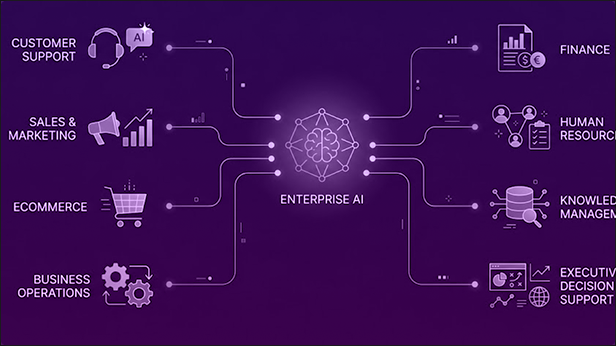
Technologies That Power Our AI Solutions
The AI technologies and frameworks we use to build intelligent, scalable solutions
Infrastructure
Connect Autonomous Agents With Business Systems
Autonomous execution becomes useful when agents can safely interact with the systems where work actually happens.We connect agents with the required data, applications, tools, and workflows.
Business Application Integration
Connect agents with CRM, ERP, commerce, HR, finance, and operational systems.
API & Tool Integration
Provide agents with access to the APIs and functions required for their tasks.
Only defined capabilities are exposed to the agent.
Database Integration
Allow agents to retrieve approved business information from databases.Data access can follow application ants.
Workflow Engine Integration
Connect agents with existing workflow and automation systems.
Knowledge Integration
Provide agents with relevant documents and organizational knowledge.
Identity & Permissions
Integrate authentication and authorization requirements into agent workflows.
Approval & Escalation Integration
Connect critical steps with human approval and escalation workflows.
Cloud & Infrastructure Integration
Deploy autonomous agents within suitable cloud or enterprise infrastructure.
Security & Compliance Integration
Integrate agents with your organization's encryption, data governance, and regulatory requirements
Monitoring & Observability Integration
Connect agents to logging, analytics, and performance-monitoring systems already in use.
Building Autonomous AI With Practical Business Controls
Autonomous AI requires more than connecting an LLM to a workflow.We combine AI engineering, software development, integration, and control mechanisms to create practical agent solutions.

Business Process Understanding
We start with the process and identify where autonomy can create measurable value.

AI Agent Engineering
We design agents with planning, reasoning, tool usage, knowledge, and workflow capabilities.

AI & Integration Expertise
We connect agents with existing applications, APIs, databases, and business tools.

Controlled Autonomy
We design boundaries around what an agent can access and execute.

Production-Oriented Engineering
We consider reliability, monitoring, security, scalability, and maintainability.

Evolutionary AI Architecture
Start with one autonomous workflow and expand as confidence grows.
Move From AI Assistance to AI Execution
Autonomous AI agents can help businesses execute suitable workflows faster and with less repetitive manual coordination.The objective is controlled automation that improves operational capacity without losing visibility.
Faster Workflow Execution
Agents can coordinate defined multi-step activities without unnecessary manual handoffs.
Reduced Operational Effort
Automate suitable repetitive tasks that consume employee time.
Increased Process Capacity
Agents can support higher volumes of repetitive workflow execution.
Improved Process Consistency
Agents follow defined workflows, rules, and operational boundaries.
Better Human-AI Collaboration
Employees can focus on judgment and exception handling while agents manage defined execution steps.
Scalable Automation Foundation
Organizations can begin with one workflow and gradually expand autonomous capabilities.
Frequently Asked Questions
An autonomous AI agent is designed to pursue a defined objective by planning and executing multiple tasks.It can use connected tools and systems with a defined level of independence.
Not necessarily. Autonomy can be designed at different levels depending on the business process and risk.Human approvals and escalation can remain part of the workflow.
Yes, agents can be connected to approved APIs, applications, databases, and tools.Access and actions can be restricted according to defined permissions.
Yes, agent capabilities can be limited through permissions, tools, business rules, and workflow boundaries.Critical operations can also require human approval.
Yes, multi-step planning and workflow execution are key use cases for autonomous agents.The agent can coordinate defined tasks based on the current context.
Agent capabilities can be restricted through tool permissions, validation rules, approval steps, and execution boundaries.Monitoring and evaluation can also help identify unexpected behaviour.
Monitoring and evaluation can also help identify unexpected behaviour.
Yes, agents can complement existing workflow engines, APIs, and automation systems.AI can handle context and decision-making while established automation executes deterministic steps.
Yes, starting with a focused and measurable workflow is often a practical approach.The solution can expand as the organization gains confidence in autonomous execution.
Success can be tracked through defined metrics such as task completion rate, accuracy, time saved, and the frequency of human intervention required.Regular review of these outcomes helps determine whether the agent's scope should expand or be adjusted.