



 React Native Development
 Angularjs 2 Development
 Angularjs Development
 Nodejs Development

 AI Development
 Agentic AI Development
 AI-Product-Engineering
 Generative AI Development
 AI Chatbot Development
 RAG Development
 AI MCP Development
 n8n Automation Development
 AI Consulting
Piccosoft

Picco Labs
Picco AI
Piccosoft

AI Agent Development Services
Build AI agents that understand, act, and get work done.
We design and develop intelligent AI agents that understand business context, interact with users, access information, and use connected tools.From a focused business agent to a complex enterprise workflow, we build agents around the way your business actually works.
Implement AI Where It Creates Real Business Value
Why Businesses Struggle to Implement AI
From Business Requirements to AI Implementation
What We Deliver
Where Can Your Business Implement AI?
Technologies That Power Our AI Solutions
Connect AI with Your Existing Business Ecosystem
Why Businesses Choose Piccosoft
Build a More Intelligent and Efficient Business
Frequently Asked Questions
AI Agents Designed Around Your Business
AI agents are more than chat interfaces they can understand context, make decisions, use tools, and perform business tasks.We engineer agents that connect intelligence with real business processes.
Intelligent Task Execution
Agents understand objectives and execute tasks through connected tools.
They can move beyond answering questions to taking action.
Context-Aware Intelligence
Agents use relevant business context before responding or acting.This helps deliver more accurate and useful outcomes.
Tool & API Usage
Agents can interact with APIs, databases, applications, and enterprise tools.They can retrieve information and trigger actions across systems.
Business Process Automation
Agents can support repetitive and multi-step business processes.They help reduce manual work while keeping humans in control.
Human-Agent Collaboration
Agents can work alongside employees rather than replacing existing workflows.Human approval can remain part of critical decisions and actions.
Scalable Agent Architecture
We design agent architectures that can evolve as business requirements grow.New tools, workflows, knowledge sources, and capabilities can be added over time.
Why Businesses Need AI Agents
Traditional automation follows predefined rules and struggles when processes require context or decisions.AI agents bring intelligence into workflows where information, reasoning, and actions need to work together.

Too Much Manual Work
Employees spend significant time performing repetitive information-based tasks.Agents can automate parts of these workflows.
Read more

Information Scattered Across Systems
Business information often exists across multiple applications and databases.Agents can bring relevant information together when needed.
Read moreSlow Business Processes
Multi-step processes often require several manual handoffs.Agents can coordinate tasks across connected systems.
Read moreLimited Access to Business Knowledge
Employees may struggle to find the right information quickly.Agents can retrieve relevant knowledge based on the user's context.
Read moreAutomation Without Intelligence
Rule-based automation cannot easily handle changing situations.AI agents can interpret context before deciding what to do.
Read moreDisconnected AI Experiences
Standalone AI tools often operate outside existing business systems.Agents can be integrated directly into the applications and workflows teams already use.
Read moreFrom Business Need to Working AI Agent
We start with the business process rather than the AI model.Our approach connects the agent's intelligence, knowledge, tools, and actions into a practical solution.
Understand the Business Process
We identify the task, users, systems, decisions, and expected outcomes.
Define Agent Responsibilities
We determine what the agent should understand, decide, and execute.
Design Agent Architecture
We define the model, memory, knowledge, tools, workflows, and orchestration.
Connect Knowledge & Data
Relevant documents, databases, APIs, and business information are connected to the agent.
Integrate Tools & Actions
We connect the agent with business applications and external services.
Test, Govern & Deploy
We evaluate agent responses, actions, security, and reliability before deployment.
Capabilities We Build Into AI Agents
Our agents can combine reasoning, knowledge retrieval, tool usage, memory, and workflow execution.Each capability is designed around the specific responsibilities of the agent.
Natural Language Understanding
Agents understand user requests expressed in natural language.
They can interpret intent, context, and required actions.
Reasoning & Decision Support
Agents can analyse information and determine appropriate next steps.
They can support decisions within defined business boundaries.
Knowledge Retrieval
Agents can retrieve relevant information from connected knowledge sources.Responses can be grounded in business-specific information.
Tool Calling
Agents can use APIs, functions, databases, and external tools.This enables agents to perform actions rather than only generate text.
Agent Memory & Context
Agents can maintain relevant context during interactions and workflows.
This enables more consistent and personalized experiences.
Workflow Orchestration
Agents can coordinate multiple steps required to complete a task.
Complex workflows can be structured into manageable actions.
Human-in-the-Loop
Critical actions can require employee review or approval.This provides control over sensitive or high-impact processes.
Monitoring & Evaluation
Agent interactions and outcomes can be monitored against defined objectives.Evaluation helps improve reliability and performance over time.
Where AI Agents Can Work for Your Business
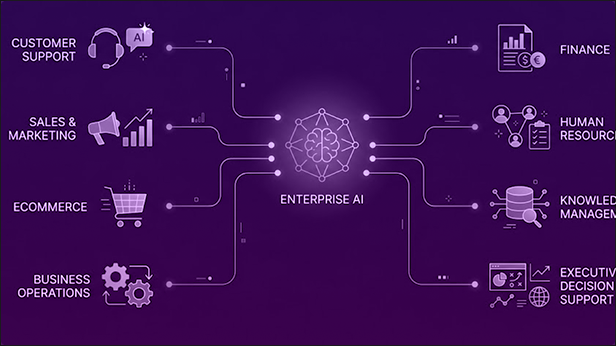
AI agents can support employees, customers, operations, and business processes across different functions.We build agents around specific tasks rather than forcing generic AI into existing workflows.
1. Customer Support Agent
Understand customer questions and retrieve relevant information from business systems.
2. Sales Agent
Help sales teams research prospects, access customer information, and prepare responses.
3. Employee Assistant
Provide employees with access to internal information and business processes.
4. Research Agent
Collect and analyse information from approved sources based on a defined objective.
5. Operations Agent
Support operational workflows by retrieving information and coordinating tasks.
6. Finance Agent
Assist with financial information retrieval, analysis, and defined workflows.
Technologies That Power Our AI Solutions
The AI technologies and frameworks we use to build intelligent, scalable solutions
Infrastructure
Connect AI Agents to Your Existing Technology
An AI agent becomes more valuable when it can work with the systems your business already uses.We connect agents with applications, data sources, APIs, and enterprise workflows.
Business Application Integration
Connect agents with CRM, ERP, commerce, HR, finance, and operational systems.
API Integration
Connect agents with internal and external APIs.This allows agents to interact with existing digital services.
Database Integration
Enable agents to retrieve information from business databases.
MCP Integration
Connect AI agents with tools and systems through MCP-based interfaces.
RAG Integration
Connect agents to enterprise documents and knowledge repositories.
Workflow Integration
Embed agents into existing business workflows and processes.
Authentication & Permissions
Integrate identity, access control, and permission requirements.
Cloud & Infrastructure Integration
Deploy and operate agents within your preferred infrastructure environment.
Security & Compliance Integration
Integrate agents with your organization's encryption, data governance, and regulatory requirements
Monitoring & Observability Integration
Connect agents to logging, analytics, and performance-monitoring systems already in use.
Engineering AI Agents for Real Business Use
We combine software engineering, AI engineering, integration expertise, and business understanding.Our focus is not simply building an AI chatbot—it is building an agent that can work within your business.

Business-First Approach
We start by understanding the actual business process and expected outcome.

Strong Software Engineering
Our AI solutions are built on established application engineering practices.

AI & Integration Expertise
We combine AI capabilities with APIs, databases, applications, and workflows.

Custom Agent Architecture
We do not force every business into the same agent design.

Enterprise-Ready Thinking
Security, permissions, monitoring, scalability, and governance are considered from the beginning.

Long-Term Technology Partner
We can support the journey from initial agent concept to production deployment.
Turn AI Intelligence Into Business Action
The goal of an AI agent is not simply to generate better answers.It is to help people complete work, make informed decisions, and improve business processes.
Reduced Manual Work
Automate repetitive information-driven activities across business workflows.
Faster Task Completion
Agents can retrieve information and execute multiple workflow steps quickly.
Better Access to Information
Employees can interact with business information through natural language.
Improved Productivity
AI agents can support employees throughout everyday workflows.
Connected Business Processes
Agents can bridge information and actions across multiple applications.
Scalable AI Adoption
Start with a focused agent and expand into additional processes over time.
Frequently Asked Questions
An AI agent is a software system that can understand objectives, reason over information, use tools, and perform tasks.Unlike a basic chatbot, an agent can be designed to take actions within defined boundaries.
A chatbot primarily focuses on conversational interaction and answering questions.An AI agent can additionally use tools, access data, make decisions, and execute workflows.
Yes, agents can be designed around your specific business process, systems, and objectives.The capabilities and level of autonomy can be defined according to your requirements.
Yes, agents can integrate with APIs, databases, applications, and business platforms.Access and actions can be controlled through defined permissions.
Yes, relevant business data and knowledge sources can be connected to the agent.RAG and controlled data access can help provide context-specific responses.
Yes, human-in-the-loop workflows can be incorporated for sensitive or important actions.The agent can request approval before continuing with a defined operation.
Yes, agents can coordinate multiple steps using connected tools and workflows.The exact level of autonomy depends on the use case and governance requirements.
Yes, we can support the journey from use-case discovery and prototype through integration and production deployment.The architecture can also be designed to support future expansion.
CRM development is the process of designing and building software that helps businesses manage customer relationships, sales activities, marketing campaigns, and customer support.