



 React Native Development
 Angularjs 2 Development
 Angularjs Development
 Nodejs Development

 AI Development
 Agentic AI Development
 AI-Product-Engineering
 Generative AI Development
 AI Chatbot Development
 RAG Development
 AI MCP Development
 n8n Automation Development
 AI Consulting
Piccosoft

Picco Labs
Picco AI
Piccosoft

AI Agent Integration Services
Connect AI agents with the systems that run your business.
We integrate AI agents with your existing applications, APIs, databases, business tools, and workflows.Turn your AI agents from standalone intelligence into connected business capabilities that can access information and perform defined actions.
Implement AI Where It Creates Real Business Value
Why Businesses Struggle to Implement AI
From Business Requirements to AI Implementation
What We Deliver
Where Can Your Business Implement AI?
Technologies That Power Our AI Solutions
Connect AI with Your Existing Business Ecosystem
Why Businesses Choose Piccosoft
Build a More Intelligent and Efficient Business
Frequently Asked Questions
Connect Intelligence With Your Existing Technology
An AI agent becomes significantly more useful when it can access the information and tools your business already uses.We build the integration layer required for agents to interact with your technology environment.
Business System Connectivity
Connect AI agents with the applications your teams use every day.
Agents can retrieve information and perform approved actions.
API & Tool Integration
Expose the right APIs and business functions to your AI agents.
This enables agents to interact with digital services in a controlled way.
Enterprise Data Access
Connect agents with approved databases and information sources.
Relevant business data can become available within agent workflows.
Workflow Integration
Embed AI agents into existing business processes and automation workflows.
Agents can support or execute defined workflow steps.
Secure Agent Access
Control which systems, data, and actions each agent can access.
Permissions can be aligned with business and security requirements.
Integration Architecture
Design a reliable integration layer between AI agents and enterprise systems.
The architecture can evolve as new agents and business capabilities are introduced.
Why AI Agents Need Integration
A standalone AI agent can understand information, but its business value increases when it can interact with real systems.Integration connects intelligence with the data and actions required to complete meaningful work.

AI Is Disconnected From Business Systems
Agents may operate separately from the applications employees use.This limits their ability to support real business processes.
Read more
Data Exists Across Multiple Platforms
Business information is often distributed across databases and applications.Agents need controlled access to relevant information.
Read moreComplex API Environments
Organizations may have many internal and external APIs.Selecting and exposing the right capabilities to agents requires careful design.
Read moreManual Handoffs Between AI and Systems
Employees may still need to transfer information between the AI and business applications.Integration can reduce these unnecessary manual steps.
Read moreSecurity & Permission Concerns
Not every agent should have access to every system or action.Agent integrations need clearly defined access boundaries.
Read moreLegacy & Modern Technology Together
Enterprise environments often contain both older systems and modern applications.AI integration needs to work across this technology landscape.
Read moreConnecting AI Agents Without Disrupting Your Business Systems
We start by understanding the agent's responsibilities and the systems it needs to interact with.Then we design controlled integrations that connect AI capabilities with existing business technology.
Map Agent Requirements
We identify what information the agent needs and which actions it must perform.
Map Existing Systems
We review applications, APIs, databases, workflows, and business tools involved in the process.
Define Access & Permissions
We determine what each agent should be allowed to read, create, update, or execute.
Design Integration Architecture
We define APIs, connectors, tools, orchestration, authentication, and data flows.
Build & Validate Integrations
We implement the required connections and validate data exchange and actions.
Deploy & Monitor
The integrated agent is deployed with appropriate monitoring and operational controls.
Integration Capabilities We Build
We connect AI agents with the technology required to retrieve information, use tools, and perform business actions.Each integration is designed around the agent's responsibilities and access requirements.
API Integration
Connect agents with internal and external APIs.Agents can invoke approved services as part of their workflows.
Database Integration
Connect agents with structured business databases and data sources.Information access can be restricted according to defined permissions.
Business Application Integration
Connect agents with CRM, ERP, HR, finance, commerce, and operational platforms.
Agents can interact with the systems relevant to their tasks.
Tool & Function Integration
Convert approved business functions into tools that agents can use.This allows agents to perform defined actions through structured interfaces.
Workflow Integration
Connect agents with existing workflow and automation processes.Agents can participate in selected steps without replacing established systems.
Authentication & Authorization
Implement appropriate identity and access controls around agent interactions.
Agents operate within clearly defined security boundaries.
Data Transformation
Transform information between the formats required by AI agents and business systems.This helps different technologies communicate reliably.
Integration Monitoring
Track agent-to-system interactions, failures, response times, and workflow outcomes.Monitoring helps identify and resolve integration issues.
Connect AI Agents Across Business Functions
AI agents can become part of existing business applications rather than operating as separate tools.We integrate them into workflows where access to data and actions creates measurable value.
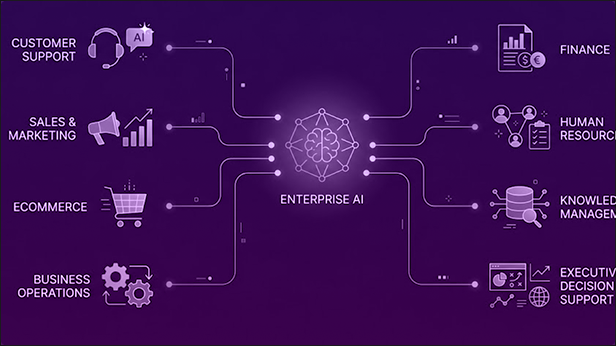
1. CRM Agent Integration
Connect sales or support agents with CRM customer and lead information.
2. E-commerce Agent Integration
Connect agents with product, order, customer, and inventory systems.
3. ERP Agent Integration
Enable agents to interact with approved ERP information and processes.
4. HR System Integration
Connect employee assistants with approved HR systems and internal processes.
5. Finance System Integration
Connect agents with financial data and approved finance workflows.
6. Customer Support Integration
Connect support agents with customer records, knowledge bases, and service systems.
Technologies That Power Our AI Solutions
The AI technologies and frameworks we use to build intelligent, scalable solutions
Infrastructure
Connect Agents Across Your Technology Ecosystem
We build the technical connections that allow AI agents to interact with the systems behind your business.From individual APIs to complex enterprise workflows, integrations are designed around controlled access and reliable execution.
CRM & Sales Platforms
Connect AI agents with customer, lead, opportunity, and sales information.
ERP & Business Platforms
Integrate agents with enterprise resource planning and operational applications.
E-commerce Platforms
Connect agents with product, catalog, order, inventory, and customer systems.
APIs & Microservices
Integrate agents with internal services and external APIs.
Databases & Data Platforms
Connect agents with approved structured business data sources.
Knowledge Systems
Connect agents with documents, repositories, and enterprise knowledge sources.
Automation & Workflow Platforms
Integrate agents with workflow engines and existing automation systems.
Cloud & Enterprise Infrastructure
Deploy integrations across suitable cloud and enterprise environments.
Monitoring & Observability
Connect integrated agents to logging, analytics, and performance-monitoring systems already in use.
Security & Compliance
Integrate agents with your organization's security controls, data governance policies, and relevant regulatory requirements.
Connecting AI With the Systems That Matter
AI integration requires more than connecting an API—it requires understanding how data, applications, workflows, and AI capabilities fit together.We combine AI engineering and software integration expertise to build practical agent-connected systems.

Integration-First Thinking
We start with the systems, workflows, and capabilities the agent actually needs.

AI & Software Engineering
We combine AI capabilities with application and backend engineering.

Business System Expertise
We understand how enterprise applications, databases, APIs, and workflows interact.

Secure Access Design
Agent access can be restricted to the systems and actions required for its role.

Scalable Architecture
Integration architecture can support multiple agents, systems, and workflows.

Production-Oriented Delivery
We consider reliability, monitoring, error handling, security, and maintainability.
Turn AI Agents Into Connected Business Capabilities
Connecting agents to your technology ecosystem allows AI to move from conversation toward meaningful business activity.The result is a more integrated approach to AI-driven workflows.
Connected AI Workflows
Agents can access the systems required to complete defined tasks.
Reduced Manual Handoffs
Information can move between AI and connected systems automatically.
Faster Task Execution
Agents can retrieve information and invoke approved business functions directly.
Better Use of Existing Systems
Organizations can add AI capabilities without replacing their current technology stack.
Improved Operational Productivity
Employees can use AI to interact with multiple systems through a simpler experience.
Scalable AI Integration Foundation
New agents and integrations can be added as business requirements expand.
Frequently Asked Questions
AI agent integration connects an AI agent with business applications, APIs, databases, tools, or workflows.It allows the agent to access information and perform defined actions.
Yes, agents can be integrated with applications that provide suitable APIs, services, or integration mechanisms.The approach depends on your existing technology architecture.
Yes, where appropriate, agents can access approved business data through controlled integration layers.Direct access should be designed carefully around security and data requirements.
Yes, approved actions can be exposed to agents through APIs, tools, or defined functions.Permissions and approval controls can restrict what the agent is allowed to execute.
Integration depends on the interfaces and capabilities available in the legacy environment.Where direct APIs are unavailable, other controlled integration approaches may be considered.
Security can include authentication, authorization, role-based access, controlled tools, data restrictions, and monitoring.The specific controls depend on the systems and business requirements.
Yes, integrations can be introduced incrementally as new use cases emerge.A modular architecture helps add systems and capabilities without redesigning the entire solution.
Yes, we can support the journey from use-case discovery and prototype through integration and production deployment.The architecture can also be designed to support future expansion.
Agent integrations can be designed with adaptable connectors and defined interfaces, so updates to underlying systems can be accommodated with minimal disruption.
Ongoing support can help identify and resolve integration issues as connected systems evolve.